Q1 2025 Update: Volatility Returns, Diversification Holds Its Ground
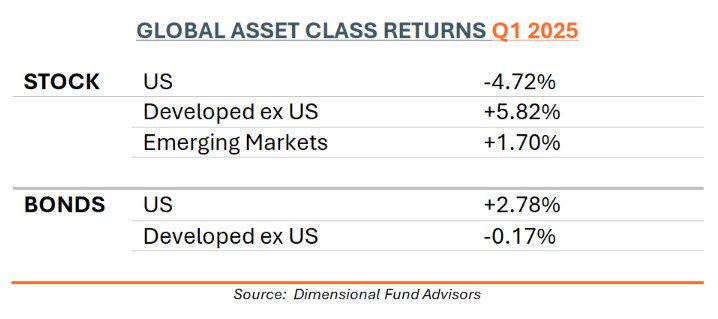
If we were to simply post first quarter numbers, the picture would suggest a fairly typical quarter: U.S. stocks down modestly, international stocks up, and bonds doing their job. Global asset class returns through March 31, 2025, are summarized in the chart below:
But that snapshot already feels outdated. Much of what investors are reacting to now unfolded in just the past few weeks. As of April 11, 2025, the S&P 500 was down 8.8% year-to-date. More than the numbers, it’s the feeling that stands out: the year has been a roller coaster, and the sense of uncertainty is real, driven largely by rising concerns related to tariffs and rapidly changing policy. Rather than rehash a quarter that no longer reflects current conditions, we find it more useful to focus on what’s happening now and how we’re thinking about it.
Portfolio Diversification is Working
Over the past year, we’ve pointed out how concentrated the U.S. stock market had become—with just seven companies making up more than a third of the S&P 500—and how expensive those stocks were by historical standards. Meanwhile, other parts of the global market were priced much more reasonably.
Yet many investors began to question the need for diversification. The thought was, why invest abroad when U.S stocks were performing so much better? In defense of the fundamental principle of diversification, we wrote back in January:
“A well-balanced portfolio must include non-U.S. stocks—perhaps now more than ever. The valuation gap reflects that international markets are simply priced differently… and while that may be justified, it also suggests that if U.S. stocks struggle, lower valuations abroad could provide a cushion.”
And in the early months of 2025, that dynamic has played out. U.S. stocks struggled during the first quarter, and the selloff deepened in April. Meanwhile, a globally diversified portfolio—with exposure to international stocks and bonds—has held up better than portfolios heavily concentrated in last year’s top performers. For example, as of March 31, 2025, the Dimensional Global Allocation 60/40 Portfolio was down just 3.46%, compared to nearly 9% for the S&P 500.
What Should We Be Doing?
In times like these, the question we hear most often is: What should we be doing?
And the honest answer is that the most important work has already been done. It happened when we built your financial plan and designed a portfolio to support it. That plan was built with the understanding that downturns and volatility are part of investing. That was the preparation. Our job now is to stay with that plan—to remain disciplined, even when it’s uncomfortable.
Could markets go lower from here? Yes. Most bear markets involve declines of around 30%, and we’re not anywhere close to that yet. Could they bounce back just as quickly? Yes. Could we time it perfectly if we tried? Probably not. And if we did, it would almost certainly be due to luck. The most sensible thing to do is to stay the course.
That said, there are still things we are doing. For example, we’re looking for opportunities to rebalance and harvest losses where appropriate. But these are tactical adjustments, not a change in strategy. The long-term plan remains in place.
Yes, This Time Is Different—But One Thing Hasn’t Changed
Every market pullback has its own story. This one includes a new round of tariff threats and rising geopolitical tension—both of which have added to investor unease. And yes, this time feels different, because the headlines are different.
But one thing hasn’t changed: the companies you’re invested in are still showing up every day—serving customers, solving problems, managing costs, and working relentlessly to deliver a return for their shareholders, including you. While we stay the course as investors, the companies we invest in are adjusting, adapting, innovating and working to produce profits.
We’re Here For You
We know this stretch has been uncomfortable. So, if you have questions or just want to talk through what’s going on—we’re here. But more importantly, we want you to know that your plan is working. Your portfolio is doing what it was designed to do. And the principles behind both haven’t changed.
Core Wealth Management is a fee-only wealth management firm located in Jupiter, FL. Our CFP® professionals provide investment management, financial planning and advisory services, while always strictly abiding by the highest fiduciary standards. For more information, contact us today at 561-491-0231.
Todd Schanel, CFP®, CPA, CFA, is the Principal and Director of Investment Advisory Services at Core Wealth Management.
Please click here to read our blog disclosure.