React or Relax? What To Do When Policy and Markets Collide
About fifteen years ago, as markets began recovering from the Great Recession, someone remarked, “The market wouldn’t have recovered if the government hadn’t stepped in with those bailouts.”
We saw this dynamic again five years ago with the response to COVID-19. For a brief moment, it seemed like we were headed for a depression—but policymakers stepped in.
In the past few months, we’ve seen a similar pattern with tariff policy.
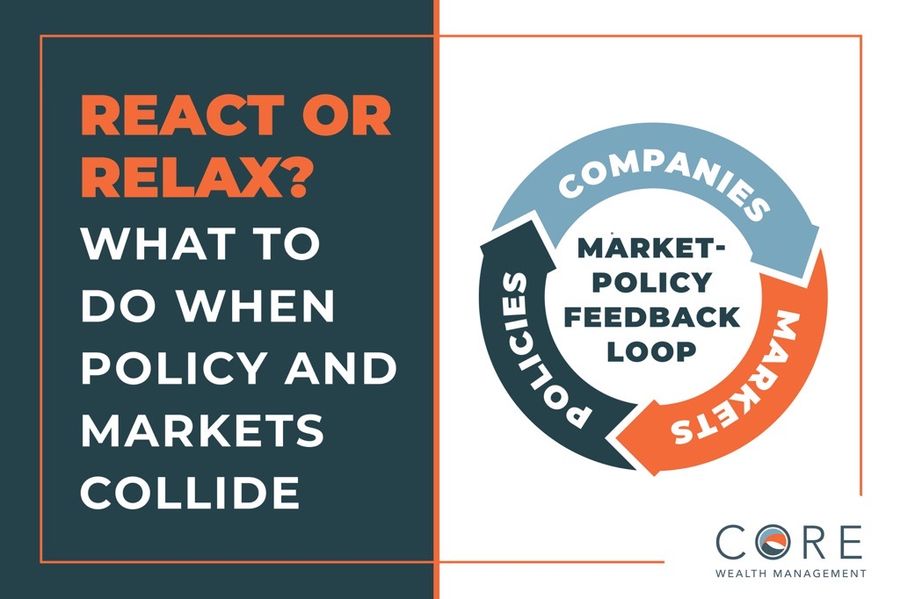
We can debate whether those bailouts were right or wrong, but that is not what matters. What is critical to understand is that markets and government policies are connected. When markets move, policymakers respond. This is known as a market-policy feedback loop.
The Tariff Tantrum and Market Reactions
In early April, the White House imposed a 10% tariff on almost every import, followed by “reciprocal” rates of up to 145% for countries with large trade surpluses. This move, called “ Liberation Day” by President Trump, sent shockwaves through global markets. The S&P 500 dropped over 4.8% on April 3rd and continued its decline, resulting in a two-day loss of approximately 10.5%. By April 8th, the S&P 500 reached its lowest closing point of the year at 4,982.77 —an 18.9% drop from its February peak of 6,144.15 .
The sell-off extended to the bond market as well. U.S. Treasury prices fell, and yields climbed. This volatility reportedly pushed key advisors to urge the President to adjust course.
Adjusting Course
Here’s what followed:
- April 9, 2025: A 90-day pause on many reciprocal tariffs. Planned hikes for 57 partners were halted, though tariffs on autos, steel, and aluminum remained at 25%. Markets rallied.
- April 13, 2025: Smartphones, laptops, semiconductors, and flat panels were excluded from the new tariffs. Tech shares climbed.
- Late April 2025: Relief on auto tariffs was introduced, with credits covering up to 15% of car and light-truck import duties after industry pushback. The market continued to climb.
- May 9, 2025: A limited trade agreement with the U.K. paused some duties and set the framework for more talks. The market continued to recover.
- May 12, 2025: The U.S. and China agreed to a truce, cutting tariffs on Chinese goods from 145% to 30% , with China lowering its duties to 10% for 90 days. Stocks surged on the news.
As the economic strain from the tariffs grew too intense, policies shifted, and markets responded accordingly. Once again, just as we saw during COVID and the Great Recession, the market-policy feedback loop completed its cycle.
It is important to note that it is not just policymakers who adjust; companies do as well. For example, when tariffs were first imposed in early 2025, companies moved fast:
- Apple shifted production from China to India to cut costs.
- Wyze, a smart home company, moved its manufacturing to Vietnam.
- Nvidia expanded its investments in U.S. supply chains.
These companies didn’t wait for perfect conditions—they adapted, innovated, and adjusted their strategies to create value for their customers and shareholders.
The takeaway is simple: markets, policies, and companies don’t operate in isolation; they respond to changing conditions, creating a continuous feedback loop.
The good news? As investors, we don’t need to predict every twist and turn—after all, that is virtually impossible, and it is a losing game. As events unfold, we can be confident that markets, policymakers, and companies will react—and that means that we don’t have to. We don’t need to get caught up in every headline; understanding this dynamic should provide peace of mind and help us stay committed to our long-term plan.
Core Wealth Management is a fee-only wealth management firm located in Jupiter, FL. Our CFP® professionals provide investment management, financial planning and advisory services, while always strictly abiding by the highest fiduciary standards. For more information, contact us today at 561-491-0231.
Todd Schanel, CFP®, CPA, CFA is the Principal and Director of Investment Advisory Services at Core Wealth Management.
Please click here to read our blog disclosure.